Insights

Mapped: The States Most Prepared for Power Demand Surges
Mapped: The States Most Prepared for Power Demand Surges

Articles Image

Key Takeaways

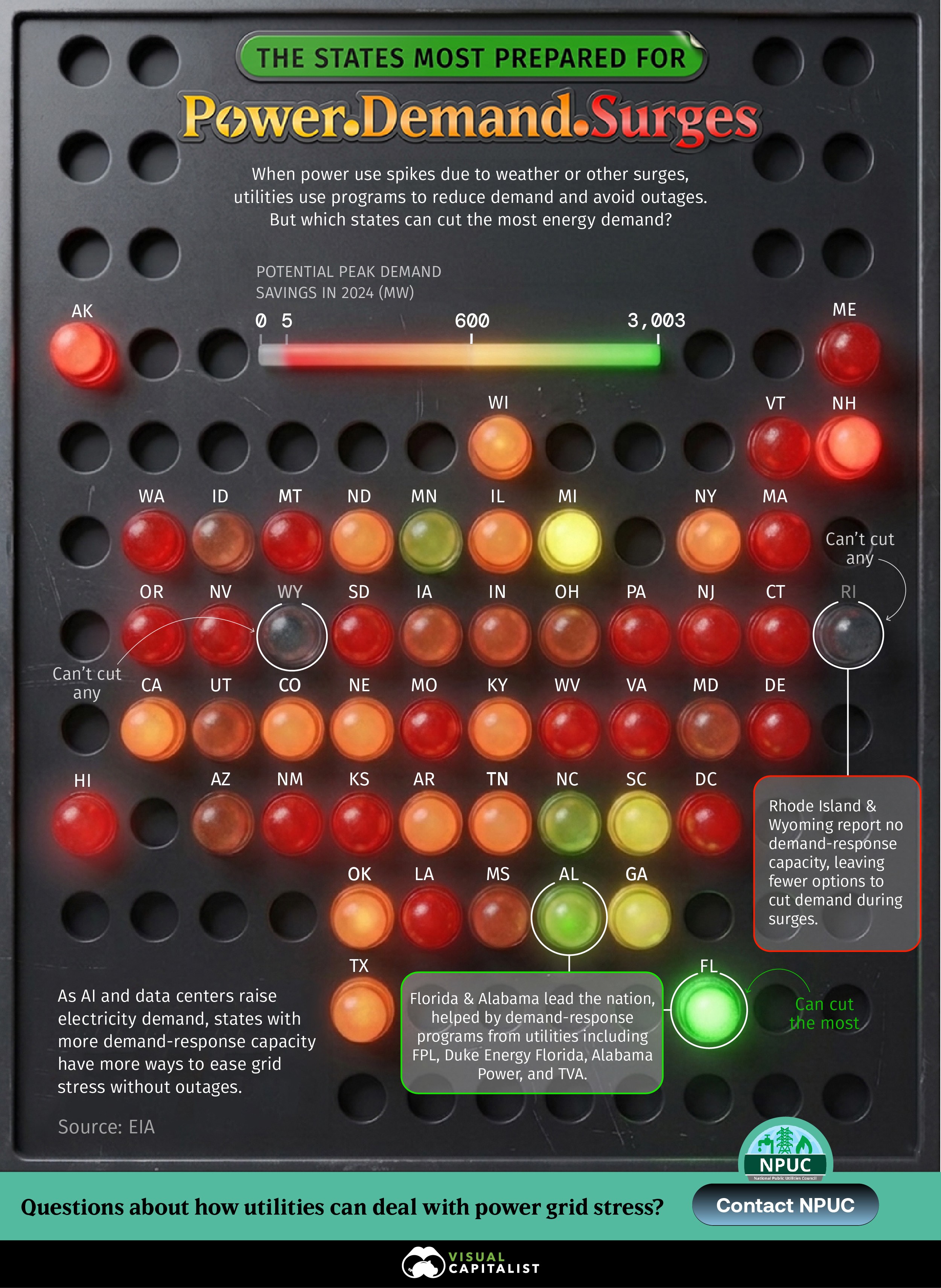
  • Florida leads all states with 3,003 MW in potential peak demand savings.

  • Alabama and Minnesota also rank highly, each exceeding 2,000 MW.

  • Rhode Island and Wyoming report no demand-response capacity.

Mapped: The States Most Prepared for Power Demand Surges

Extreme weather, electrification, AI, and data centers are putting more pressure on America’s power grids.

As demand rises, utilities need flexible tools to reduce strain before outages occur. But which states lead on flexibility?

This graphic, in partnership with the National Public Utilities Council, shows the states most prepared for power demand surges using peak potential demand savings data from the EIA.

The States That Can Cut the Most Power Demand

Demand-response programs help utilities lower electricity use during high-stress periods. For example, customers may reduce consumption or shift usage away from peak hours, often in exchange for compensation.

Here is a table showing potential peak-demand savings in MW by state in 2024.

Florida ranks first, with 3,003 MW in potential peak demand savings. Alabama follows at 2,153 MW, while Minnesota places third at 2,009 MW.

Together, these states demonstrate how demand-response capacity can buffer the grid during grid stress. Meanwhile, data center power demand continues to rise as AI adoption grows.

The Southeast Leads the Rankings

Florida and Alabama lead the nation, supported by demand-response programs from utilities including FPL, Duke Energy Florida, Alabama Power, and TVA. North Carolina, South Carolina, and Georgia also rank in the top seven.

As a result, the Southeast stands out for its ability to manage demand spikes. These programs can help utilities avoid outages without adding new generation immediately.

Where Capacity Is Limited—and Why It Matters

At the other end, Rhode Island and Wyoming report no demand-response capacity. That leaves fewer options to cut demand when electricity use surges.

Several northeastern states, including New Hampshire, Maine, and New Jersey, also report minimal demand-response capacity.

However, as U.S. electricity demand rises from data center construction after years of slower growth, demand-response programs give utilities an important tool to manage peak stress.