Breaking Down U.S. Carbon Offsets by Project Type in 2026
Key Takeaways
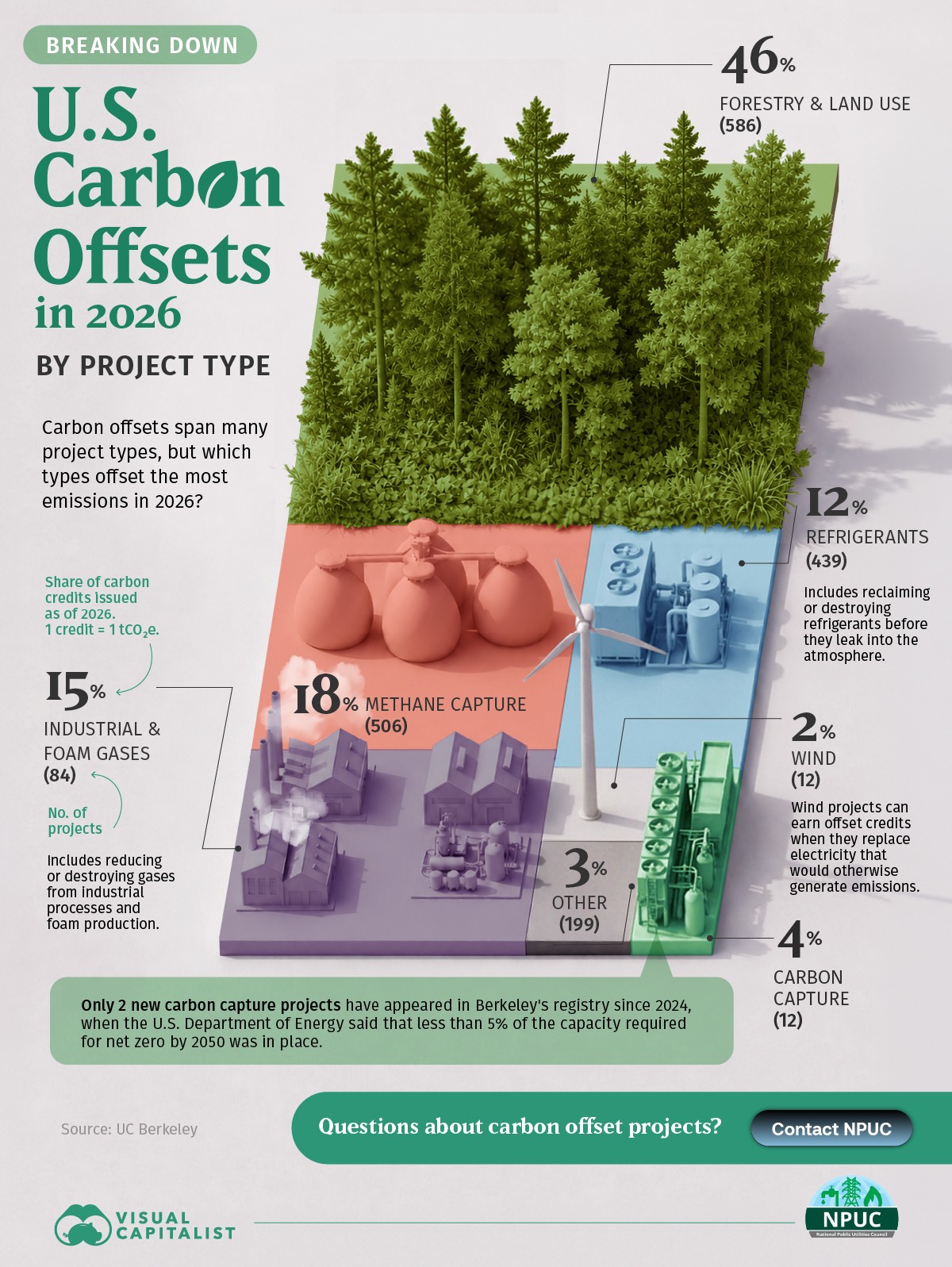
Forestry & Land Use leads U.S. carbon offsets, with 46.4% of issued credits.
Carbon capture represents just 4% of issued credits and only 12 projects, despite its strategic importance to net zero goals.
Methane Capture and Refrigerants together represent more than half of all projects.
Breaking Down U.S. Carbon Offsets by Project Type in 2026
Carbon offsets span a wide range of projects, from forest management to wind power. Together, these activities show how emissions reductions and removals can come from both natural systems and engineered solutions.
This graphic, in partnership with Visual Capitalist, shows U.S. carbon offsets by project type in 2026, using data from UC Berkeley’s Voluntary Registry Offsets Database.
A Market Led by Land-Based Projects
The breakdown of projects highlights both the scale of established offset categories and the smaller footprint of newer carbon capture technology.
Here is a table that shows U.S. carbon offsets by revised project bucket, project count, and issued credits.
Project Type | Projects | Credits Issued | Share of Issued Credits |
|---|---|---|---|
Forestry & Land Use | 586 | 266M | 46% |
Methane Capture | 506 | 103M | 18% |
Refrigerants | 439 | 68M | 12% |
Industrial & Foam Gases | 84 | 87M | 15% |
Carbon Capture | 12 | 22M | 4% |
Wind | 12 | 13M | 2% |
Other | 199 | 15M | 3% |
Total | 1,838 | 573M | 100.0% |
Berkeley VROD project types were grouped into seven buckets. Forestry includes forest, grassland, and wetland projects; Methane includes landfill, manure, mine, wastewater, and biogas projects; Refrigerants and Industrial & Foam Gases include high-impact gas recovery, replacement, or destruction; Carbon Capture includes concrete, plastics, and EOR projects; Wind includes registry-listed wind offsets; Other includes smaller remaining categories. Excludes canceled, withdrawn, and inactive projects.
Across major voluntary registries, forestry and land use lead with 586 projects and 266 million credits, equal to 46% of issuance. Methane capture follows at 18%, while industrial and foam gases contribute 15%, and refrigerants add 12%.
Together, those four categories account for more than nine in 10 credits issued. By contrast, wind contributes 2%, other projects 3%, and carbon capture just 4%.


