To keep the increase in global temperatures to 1.5°C, the International Energy Agency (IEA) states that the world must triple its renewable power capacity by 2030.
However, swift and widespread adoption depends on the removal of various bottlenecks in project pipelines worldwide.
We’ve partnered with the National Public Utilities Council to visualize data from the IEA and the Energy Transitions Commission to highlight three areas of improvement, critical to the rapid adoption of renewables.
1. Planning and Permitting
Currently, regulatory and administrative barriers lead to lengthy project timelines worldwide.
A wind project, for example, can take 10–12 years of development, while solar projects can take four years.
The Energy Transitions Commission suggests a faster process, including quicker site mapping, permit applications, and environmental surveys.
Policymakers can help reduce project timelines by allocating land for renewables, setting permit targets, and digitalizing the permit application process. As a result, the development time for wind projects could be reduced to 4.5–5.5 years, and solar projects could be online in one year.
2. Grid Availability for Wind and Solar Power
Connecting renewable energy projects to the grid has posed a challenge.
As of 2023, almost 1,500 gigawatts (GW) of wind and solar power projects in advanced stages of development were still off the electricity grid.
Excluding China and India, transmission and distribution investments have increased by only 1% annually since 2010. According to the IEA, however, government and stakeholder investment in grids must double to over $600 billion annually to meet climate targets.
3. Supply Chain Diversification
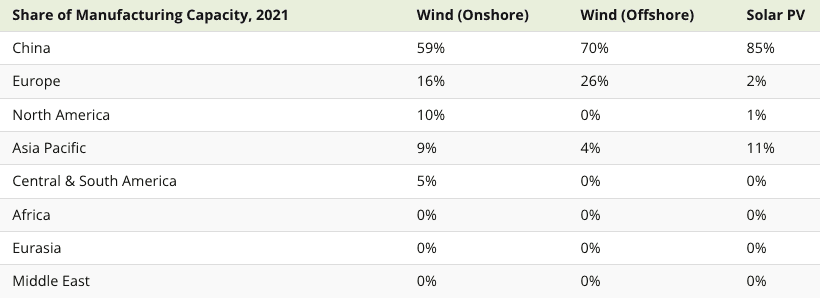
The final area for improvement, when it comes to expediting global wind and solar power scale-up, is supply chain diversification.
Currently, China heavily concentrates the global manufacturing capacity on clean energy, leading to a heavy dependency on imports for the rest of the world.