U.S. States Winning and Losing Data Center Market Share
Key Takeaways
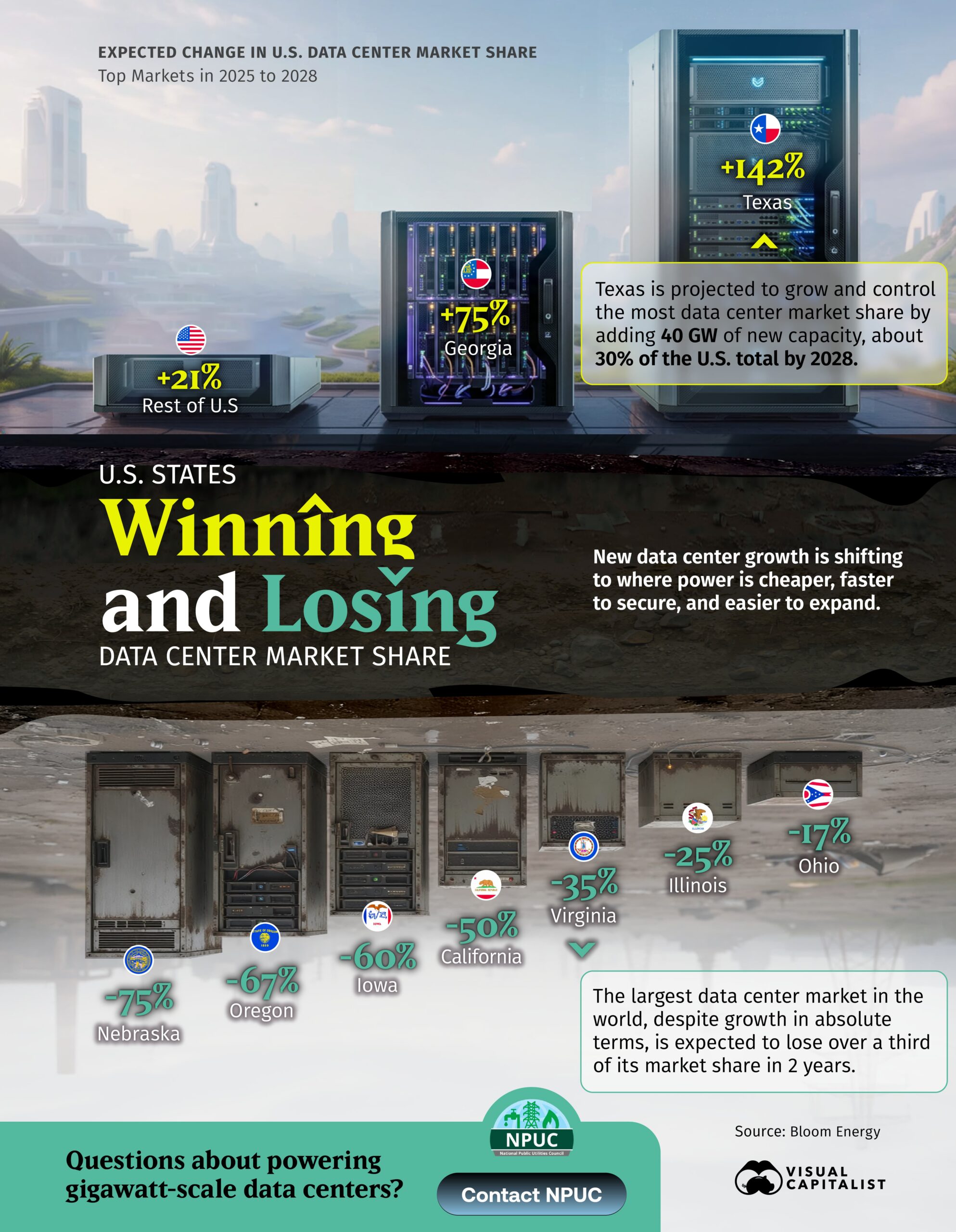
- Texas (+142%) is expected to have the largest increase of data center market share, while Nebraska (-75%) loses the most by 2028.
- Virginia (-35%) is the largest data center market in the world and is expected to lose over a third of its relative market share despite absolute growth by 2028.
- The rest of the U.S. (+21%) will gain market share while select legacy markets like California (-50%) and Oregon (-67%) lose.
U.S. States Winning and Losing Data Center Market Share
Demand for new data centers is soaring across the United States. By 2028, the projected growth of total U.S. load capacity for data centers is about 150 GW.
That’s nearly double the 80 GW capacity from 2025 and the equivalent of 75 Hoover Dams worth of power demand.
In response, new growth is shifting to places where power is cheaper, faster to secure, and easier to expand.
This graphic, in partnership with the National Public Utilities Council, shows which U.S. states may win or lose data center market share by 2028. It uses data from Bloom Energy’s 2026 Data Center Power Report.
Redrawing the Data Center Market Map
Power availability, or lack of it, is redrawing the traditional map of U.S. data centers.
The table below shows the expected change in U.S. data center market share among the top markets in 2025 to 2028:
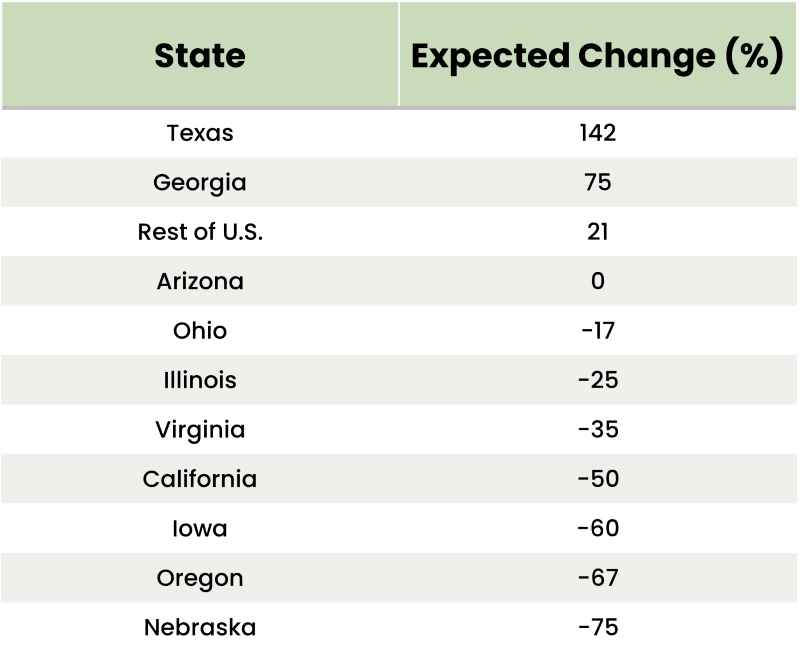
Here, market share means each state’s slice of the overall U.S. market. Expected change is how much that slice will increase or decrease over time.
Everything is Bigger in Texas
By 2028, Texas has the largest expected growth of any U.S. state with an increase of 142%. This is an addition of over 40 GW, or about 30% of the total projected U.S. capacity of 150 GW.
This means that in two years the lone star state will grow the most and control the most in terms of U.S. market share.
Following Texas is Georgia (+75%) with the second-largest gain while the rest of the U.S. will grow by 21% overall.
The geographic shift in growth suggests that developers are moving future growth away from legacy markets towards the Southeast.
Legacy Markets: Falling from Grace
Unlike the Southeast, many legacy markets are losing market share. The largest expected loss is Nebraska (-75%), followed by Oregon (-67%), then Iowa (-60%).
Most notable declines may be in California (-50%) and Virginia (-35%), two states tied closely to data centers.
California is home to Silicon Valley, the HQ hub for many of the tech companies driving the data center market forward, like Apple, Meta, and Google.
Virginia is currently the largest data center market in the world and home to 35% of the world’s known hyperscale data centers.
Despite growth in absolute terms, market share decline is expected in both states. This indicates developers are turning to new regions with fewer grid constraints for future expansion.
Learn more about how electric utilities and the power sector can lead on the path toward decarbonization here.